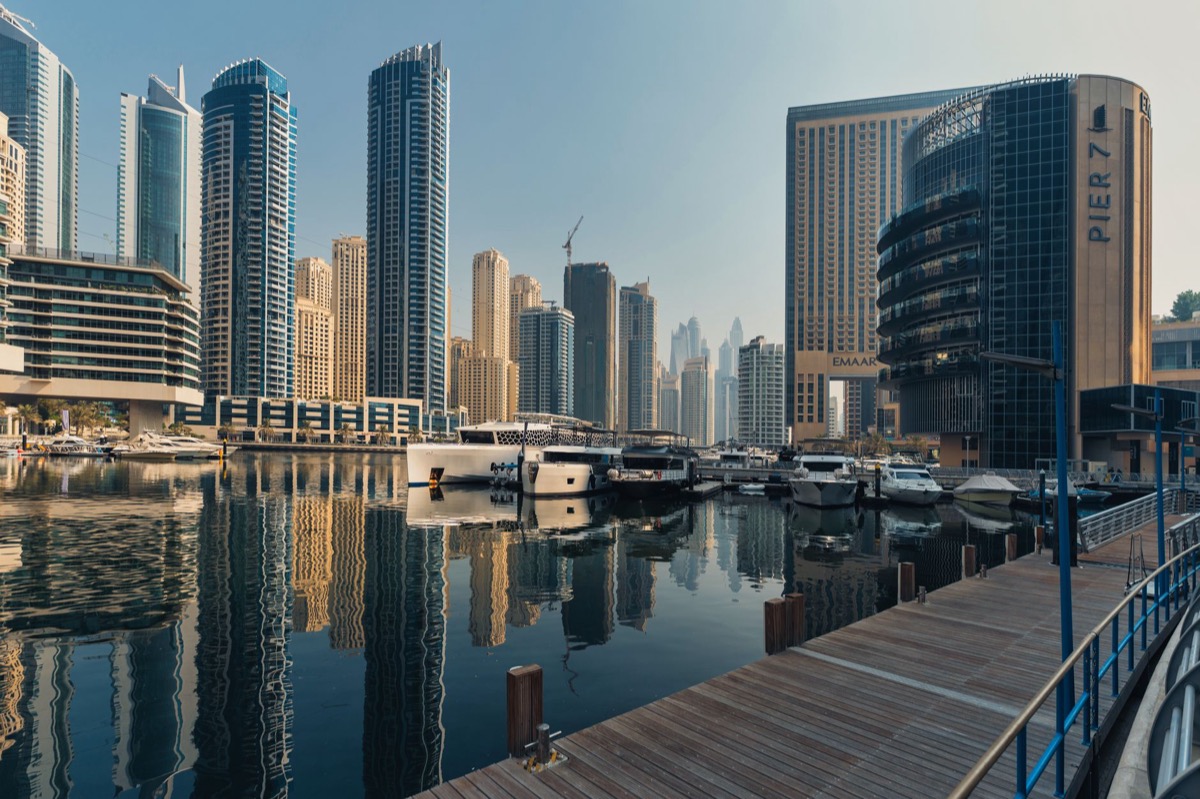
- Dubai handles roughly $25-35 billion in electronics re-exports annually, primarily phones and accessories.
- Two clusters dominate: Deira (Al Sabkha and Naif districts) for traditional traders, and JAFZA / DAFZA / DMCC for free-zone re-export operations.
- The UAE's free-zone structure means re-exported electronics avoid the 5 percent VAT and 5 percent import duty that apply to mainland sales.
- Primary onward markets from Dubai: East Africa (Kenya, Tanzania, Ethiopia), West Africa (Nigeria, Ghana), South Asia (Pakistan, Bangladesh), CIS countries.
- Dubai sees the highest volume of US-spec and EU-spec iPhone re-export trade because of the dual-SIM-friendly Asia-spec demand from regional resellers.
Why does Dubai dominate regional wholesale electronics?
Dubai's position as a wholesale electronics hub is built on three structural advantages that don't exist together anywhere else in the region.
First, the free-zone framework. Goods entering Jebel Ali (JAFZA), Dubai Airport Free Zone (DAFZA), or DMCC's licensed zones can be held, repackaged and re-exported without paying UAE import duty (5 percent) or VAT (5 percent). For a wholesaler buying iPhones in HK and selling them onward to Lagos, that means Dubai costs nothing to flow through.
Second, the logistics density. DXB and DWC airports together handle more cargo than any other region globally outside Hong Kong and Memphis. Jebel Ali Port is the largest container port between Rotterdam and Singapore. Daily flights to every major African and South Asian capital make next-day delivery realistic.
Third, the trader culture. The Deira-based Indian, Pakistani and Iranian trading communities have moved electronics in volume since the 1990s. Knowledge of regional spec preferences, payment patterns and customs paths is concentrated in a few square kilometres.
What are the two markets within Dubai?
Deira (the old market)
Al Sabkha and Naif districts host hundreds of mobile phone wholesalers operating from small storefronts and apartment-block offices. The trade is cash-heavy, relationship-driven, and runs predominantly on WhatsApp groups segmented by community and category.
Typical Deira wholesaler: 1 to 5 employees, $2M to $15M annual turnover, focus on resale into specific country corridors (Pakistan, Iran, East Africa). Margins are thin, volumes are large, payment terms are short.
What works in Deira: physical inspection of stock, cash-on-delivery within Dubai, fast local-currency settlement, deep knowledge of regional spec demand.
The free zones (the institutional market)
JAFZA, DAFZA, DMCC and DSO host larger, regulated trading entities operating under FZE (Free Zone Establishment) or FZ-LLC structures. These traders typically handle larger orders, work on letter-of-credit or T/T payment, and serve institutional buyers (carriers, retail chains, MVNOs) across Africa and CIS.
Typical free-zone trader: 10 to 100 employees, $20M to $300M annual turnover, multiple currency capabilities, formal compliance and trade-finance infrastructure.
What are the onward markets from Dubai?
Dubai is fundamentally a re-export hub. The vast majority of electronics flowing through it leave again within 30 to 90 days. The major destinations:
| Market | Primary categories | Spec preference | Payment pattern |
|---|---|---|---|
| East Africa (KE, TZ, ET) | Mid-tier Android, used iPhones | Asia / GCC spec | T/T, sometimes L/C |
| West Africa (NG, GH) | Used iPhones, refurbished Android | EU / GCC / US | T/T, escrow |
| Pakistan / Bangladesh | Used phones, accessories | Asia spec | Cash + hawala (informal) |
| CIS (UZ, KZ, AZ) | New mid-tier, accessories | EU spec | T/T, USD |
| Iran | Used phones, components | Asia spec | Cash, AED, hawala |
| Iraq, Yemen | Mid-tier and used | GCC spec | T/T, cash |
What gets traded most in Dubai?
Across Dubai's wholesale market, the highest-volume categories in 2026:
- Used iPhones (Grade A and B), particularly iPhone 12, 13, 14 series, for resale into Africa and South Asia.
- Mid-tier new Android (Samsung A-series, Xiaomi Redmi), for budget retail across emerging markets.
- iPhone 15 series, both new and CPO, for affluent African and CIS markets.
- Phone accessories, cases, cables, chargers, moving from China through Dubai to African retail.
- Laptops (Dell, HP, Lenovo), particularly business-class refurbished, for African corporate buyers.
- Network equipment, routers, switches, components, for telecom infrastructure markets.
What are the UAE-specific compliance considerations?
For traders operating in the mainland (not free zones), three compliance points to know:
- TDRA (Telecommunications and Digital Government Regulatory Authority) registration. Phones sold in the UAE mainland must have a valid TDRA registration (formerly TRA). Grey-market phones can be detected at customs and fined.
- VAT (5 percent). Applies to mainland sales. Free-zone-to-free-zone transfers are zero-rated.
- Customs duty (5 percent). Applies to mainland imports above declared free-zone entries.
For free-zone re-export operations, none of this matters: goods enter and leave without UAE tax exposure.
What trader profile thrives in Dubai?
- Multi-corridor traders with relationships across two or more onward markets (e.g. East Africa + Pakistan).
- Spec-flexible buyers who can move US-spec, EU-spec and Asia-spec stock to different downstream customers.
- Currency-flexible operations able to settle in USD, AED, EUR and occasionally crypto.
- Logistics-integrated traders with their own forwarding and customs clearance, a major advantage on margin and timing.
How do you find counterparties in Dubai?
Three paths:
- WhatsApp groups. The Dubai trading community has hundreds of group chats segmented by community and category. Access requires introduction.
- Trade shows. GITEX (October, Dubai World Trade Centre) and the Mobile World Congress satellite events draw most regional traders.
- Structured platforms. Aikon has a heavy concentration of Dubai-based companies. Filtering the feed by "UAE stock location" or "UAE-based seller" surfaces verified counterparties without requiring group introductions.
How do Dubai traders use Aikon?
Among Aikon's active companies, Dubai is the single largest concentration of registered traders. The platform is particularly used for:
- Sellers wanting reach beyond their existing WhatsApp networks, especially into East Africa and CIS.
- Buyers in other regions sourcing from Dubai-held stock without travelling.
- Private offer posting, common where Dubai sellers don't want competitors to see their pricing structure.
- Traders can send their own offers through Aikon's optional WhatsApp posting channel and publish them as structured offers.